



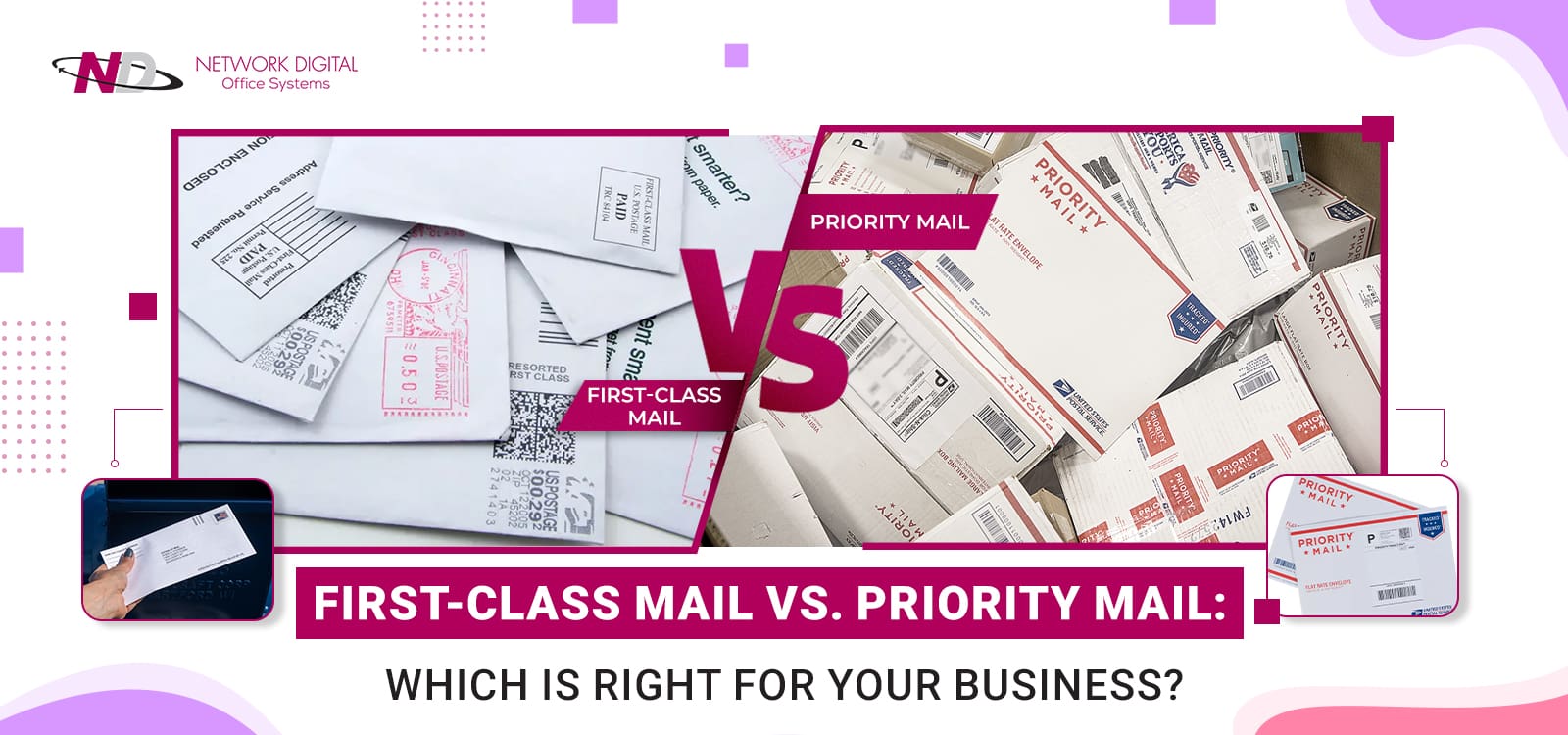
Choosing between First-Class Mail and Priority Mail affects more than postage costs. The right shipping method influences delivery times, customer satisfaction, tracking capabilities, and overall mailroom efficiency.
Whether you’re sending invoices, contracts, customer orders, or business documents, understanding when to use each USPS service helps reduce mailing costs while ensuring every shipment reaches its destination on time.
This guide compares First-Class Mail and Priority Mail to help you make informed shipping decisions for your business.
What Is First Class Mail?
First-Class Mail is USPS’s standard service for sending lightweight business correspondence, including invoices, statements, contracts, postcards, and letters. It provides an economical option for routine mail that doesn’t require package tracking or expedited delivery.
The USPS First-Class Mail service covers typical business correspondence sent in an envelope or as a flat mailing piece. This is the default delivery method for most businesses sending statements, bills, notices, postcards, and personal letters to customers. Knowing how to purchase first-class postage will save your business a common headache of delayed deliveries.
When you ship using First-Class Mail, you pay a flat rate based on shape and weight, no matter how far your recipient is. This is because a letter from one side of town to the other side of the country costs the same as one from one side of town to the other side of the country.
First-Class Mail includes three mailing formats:
- Postcards have a max size of 6 by 4.25 inches and a max thickness of 0.016 inches.
- Letters must weigh no more than 3.5 oz and must be rectangular and flexible. The letter envelope can be no more than 0.25 inches thick.
- Large Envelopes (Flats) can weigh up to 13 ounces. They have the same rectangular and flexible requirements as letter envelopes and can be up to 0.75 inches thick.
The standard First-Class Mail Forever stamp is $0.73 for 1 ounce in 2026, while meter mailers can take a 4-cent discount, or $0.69. The piece is automatically upgraded to Priority Mail or Ground Advantage if the large envelope weighs more than 13 ounces.
Tracking and insurance are not included with standard First-Class Mail. Businesses that require proof of mailing or delivery can add services such as Certified Mail or Signature Confirmation.
What Is Priority Mail?
If you are shipping products or materials that exceed the weight limits of typical postal services, you will need to upgrade your postal tier. Normal mail is okay for letters and small documents. Still, you need a more powerful, durable, and speedy domestic postal service for heavier shipments.
USPS Priority Mail offers a quick, reliable option with built-in services to meet the needs of any business or e-commerce provider. You can ship anything up to 70lbs or 108 inches in length plus girth with Priority Mail.
Priority Mail comes with two guarantees free of charge that aren’t offered with typical mail:
- USPS Tracking: your package’s location history and live delivery updates will be included.
- Insurance Coverage: USPS Commercial shipments include $100 in insurance.
Priority Mail pricing is available through two methods:
- Weight and Zone Pricing: Your shipping costs are determined by the package’s overall weight and the shipping zones the item travels through.
- Flat Rate Pricing: The shipping service “if it fits, it ships” comes with a unique set of flat-rate Priority Mail boxes and envelopes available for free from the USPS. Your shipping cost is the same for sending your package anywhere in the country, regardless of weight (up to 70 lbs.) or shipping zone.
Priority Mail service starts at $10.20 (for retail postage rates) in 2026. Still, prices can be significantly reduced by using postage software or a business account. This is perfect for shipping customers’ merchandise or heavy documents.
What is the Difference between First-Class Mail and Priority Mail?
Choosing between First-Class Mail and Priority Mail comes down to four factors: delivery speed, shipment weight, tracking requirements, and overall shipping cost. Understanding these differences helps businesses select the right service for every shipment.
First-Class Mail and Priority Mail serve different business needs. First-Class Mail is intended for lightweight correspondence, while Priority Mail is designed for packages requiring faster delivery, tracking, and higher weight limits.
So what exactly are the technical differences?
- Delivery Time – Priority Mail typically takes 1–3 days to reach anywhere in the US and is extremely reliable. First-Class Mail can take 1–5 days depending on how far it has to travel.
- Tracking – You can expect full tracking and $100 insurance with Priority Mail out of the box. You only get tracking for First-Class Mail letters when you purchase optional add-ons, such as Certified Mail.
- Weight Limit – First-Class Mail has a 3.5 oz limit for letters and a 13 oz limit for large envelopes. Priority Mail will let you ship heavier items (up to 70 lbs).
- Packaging – You’ll need your own envelopes for First-Class Mail. Still, you get free USPS-branded envelopes, Tyvek mailers, and cardboard boxes for Priority Mail. Priority Mail boxes can’t be used for First-Class Mail.
Here’s a direct comparison chart that breaks down these key differences based on data:
| Feature | First-Class Mail | Priority Mail |
| Best For | Letters, bills, postcards, invoices, flats | Packages, heavy documents, customer orders |
| Delivery Speed | 1 to 5 Business Days | 1 to 3 Business Days |
| Max Weight | 13 Ounces (Flats) / 3.5 Ounces (Letters) | 70 Pounds |
| Tracking | Not Included (Certified option available) | Included Automatically |
| Insurance | None | Up to $100 Included |
| Free Packaging | No | Yes (USPS Flat Rate & Standard boxes) |
| Pricing Method | Based on shape and weight | Based on weight/zone or Flat Rate |
When Should Businesses Choose First Class Mail?
Once you understand these comparisons, you can segment the mail you send out every day. Here are the types of business situations in which First-Class Mail is the service that will earn your company the most money.
Your company can consider using First-Class Mail if it needs to mail flat paper mail weighing 13 ounces or less without expediting delivery. It is the most cost-effective way to send routine business correspondence.
The most common First-Class Mail scenarios in business include:
- Monthly invoices
- Customer statements
- Tax documents
- Legal notices
- Marketing postcards
If you ship lightweight items like these, using First-Class Mail is cost-effective and guarantees delivery in approximately one week so that you won’t be paying expensive package rates for shipping documents!
When Should Businesses Choose Priority Mail?
For lightweight documents, junk mailings work fine, but your heavier client packages need stronger protection. With this upgrade, your packages make it through the domestic transit network with your customers kept well updated.
If you mail a package over 13 ounces, need tracking, ship sensitive products, or expect it within three days, your business should select Priority Mail. It’s what you and your customers want when there’s business at hand.
Below are typical business examples of when you would opt for Priority Mail:
- E-Commerce Fulfillment: Get clothes, electronics, beauty products, or decor delivered right to your customers’ front doors.
- Urgent Deliveries: Business proposals, architectural blueprints, or signed contracts delivered within hours, not days.
- Expensive Goods: Ship computers, sensitive electronic equipment, or unique manufactured parts with in-house insurance.
- Oversized & Heavy Shipments: Metal components, office supplies, or bundles delivered at under 70 lbs.
Fast, trackable shipping helps businesses build customer confidence and maintain a professional reputation. Priority Mail has everything you need for fast, tracked shipments that keep your clients satisfied.
Cost Comparison: Which Service Saves More Money?
Understanding the cost differences between these services helps businesses reduce annual postage expenses. The cost difference between these services becomes significant when businesses process large volumes of mail. Selecting the appropriate service for each shipment helps reduce postage expenses without affecting delivery requirements.
Let’s first compare first-class mail vs. priority mail pricing. First Class Mail is the most inexpensive option to ship letters and large letters – it can cost as little as $0.73 to ship a retail letter and as low as $0.69 to ship a metered letter. For a large letter under 13 oz, First-Class Mail rates range from $1.50 to $4.50 depending on weight.
USPS Priority Mail, however, is designed for packages and has a higher starting price. Priority Mail Flat Rate Envelopes cost around $9.85-$10.40, and then regular rate packages cost around $10.20 and go up from there. Before the recent 2023 postage changes, companies were comparing first class packages vs. Priority Mail for light boxes.
Let’s take an example. Imagine you need to send a 5oz contract to your client – you can ship this as:
- For a Priority Mail Flat Rate Envelope, your cost is about $9.85, and it will take 2-3 business days to arrive with tracking and $100 in insurance coverage.
- A First-Class Mail Flat will cost you $2.40 and take 3-5 business days to arrive, with no tracking or insurance.
If your contract does not require time-definite delivery, selecting First-Class Mail saves $7.45 per envelope mailed. If you send 100 contracts a month from your office, that small decision adds $745 per month to your company’s bottom line, or nearly $9,000 per year!
But let’s say your company must send a 2-pound package of goodies because First-Class Mail has a maximum weight of 13 ounces. Your options: You can use either Priority Mail or USPS Ground Advantage, your economical ground-based option that starts at roughly $7.30 (Priority Mail offers faster air delivery for a couple bucks more).
How to Choose the Right USPS Shipping Service?
Now that you have a good grasp of costs, you can implement automated routing in your mailroom. The key to this process is these three rules that your mailroom staff will use for shipping every package.
So, here is a three-step decision-making process that will help you choose the right shipping service:
- Does it weigh less than 13oz? Is it a flat letter you want to send via First-Class Mail to save money? Or is it a package that’s going through Priority Mail or Ground Advantage? This simple check of weight and size can prevent many common shipping mistakes.
- Does it have to be there soon? For time-sensitive deliveries within 3 days, you need to use Priority Mail. If you have more wiggle room, you’ll want to ship your document via First-Class Mail and your package via Ground Advantage to save money.
- Is it valuable and fragile? Then you will want to go with Priority Mail to benefit from automatic tracking and the $100 insurance that’s built in. If you are shipping low-value papers that won’t break, there’s no need to waste extra money on Priority Mail.
- Training staff to follow a consistent shipping workflow helps reduce postage costs and mailing errors.
How Mailroom Automation Improves Shipping Efficiency?
Businesses handling high mail volumes often rely on automated mailroom systems to determine the most appropriate USPS service based on document size, weight, delivery requirements, and postage costs. This reduces manual decision-making, improves consistency, and helps control mailing expenses.
For businesses sending dozens or even thousands of mailpieces each month, manually choosing the right USPS service can be time-consuming and error-prone. A modern mailroom combines the right shipping method with automation to streamline outbound mail, reduce costs, and improve delivery accuracy.
Mailroom automation solutions help businesses evaluate each mailpiece based on its size, weight, destination, and delivery requirements before selecting the most appropriate USPS service. This eliminates guesswork while ensuring every shipment is processed efficiently.
Key benefits of an automated mailroom include:
- Automatic postage calculation to apply the correct USPS rate without manual calculations.
- Postage meters that replace retail stamps and help businesses access commercial postage rates where available.
- Shipping and mailing software that simplifies label creation, postage management, and shipment processing from a single platform.
- Address verification to reduce returned mail caused by incomplete or incorrect recipient information.
- Document tracking that provides greater visibility into outgoing mail and important business shipments.
- Automated mail routing that selects the most appropriate USPS service based on delivery speed, package weight, and business requirements.
- Fewer manual errors through standardized mailing workflows that improve consistency across high-volume operations.
Rather than relying on employees to evaluate every shipment individually, automated mailroom technology helps organizations process outgoing mail faster, maintain consistent shipping practices, and control postage expenses as mailing volumes grow.
Elevate Your Document Workflow with Network Digital
Choosing the right USPS service is only one part of creating an efficient outbound mail process. Businesses can achieve even greater savings by automating postage selection, document preparation, and mail processing.
Network Digital makes it easy for businesses in New Jersey and New York. Our Mailroom Solutions deliver a better customer experience for corporate offices. From the latest postage meters to high-speed folder inserters and print security software, our team will analyze your mail volume to earn you commercial discounts, automate shipping, and remove retail markups.
Call or visit our website to set up a more productive mailroom. Network Digital – empowering your business to work smarter.
Frequently Asked Questions
1. Is Priority Mail Faster Than First Class Mail?
Yes. Priority Mail, which reaches every part of the country in just 1-3 business days, and First-Class Mail (which comes in at 1-5 business days for postcards, letters, and flats) are your best bet for delivering your commercial products and custom orders.
2. Does First Class Mail Include Tracking?
No. Basic First-Class Mail letters and flats come with no tracking. Companies can get this functionality by choosing Certified Mail or by moving up to Priority Mail or Ground Advantage services. Those services provide full tracking from sending to delivery, along with proof of delivery.
3. Can I Use A Priority Mail Box For First Class Mail?
No. The Post Office has rules stating that USPS Priority Mail packaging MUST be mailed via Priority Mail. So if you use that packaging with First-Class Mail, the postal service will still charge you Priority Mail rates.
4. What Happened To First Class Package Service?
It looks like USPS has moved on, and the First-Class Package service has been discontinued since July 2023. They have merged everything from that class into one small package called USPS Ground Advantage. If you want to send a parcel via USPS, you now have to use Ground Advantage for packages up to 70 lbs.
5. Which Service Is Better For Shipping E-Commerce Products?
Priority Mail is generally the better option for urgent or higher-value e-commerce shipments because it includes tracking, faster delivery, and insurance. For lightweight, lower-value packages, USPS Ground Advantage often provides a more economical alternative.